
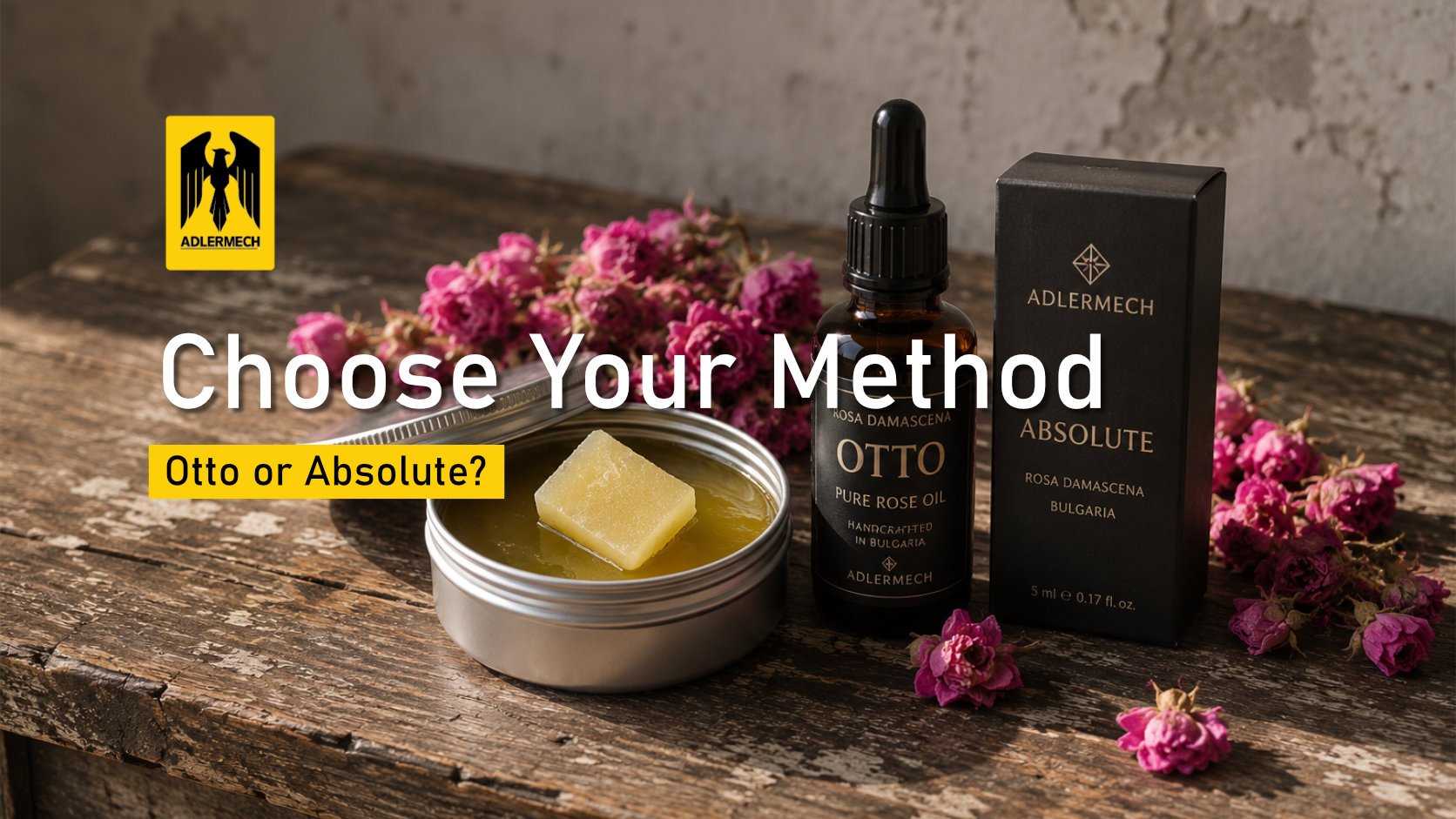
A practical comparison for producers and perfumery buyers.
Two paths lead from the flower to the fragrance. Both extract aromatic compounds; both have earned their place in the industry. But they serve different ends — and choosing between them determines not just your product, but your economics, your shelf life, and the scent character you can deliver to the buyer.
“If stability and purity are your priority, distillation stands out. If yield and aromatic richness are your priority, extraction does.”
Steam distillation is the older and simpler process. Water carries volatile aromatic molecules through heat, the vapor condenses, and the oil — the otto — separates. The result is chemically clean: free of solvent residues, low in pigments and waxes, resistant to oxidation. Ottos are hardy goods. They travel well, store long, and behave predictably on the perfumer’s bench. The capital cost of setting up a still is modest relative to extraction infrastructure, and operating a distillation run requires less technical overhead.
Solvent extraction takes a different position. Hydrocarbon or ethanol solvents pull a far broader spectrum of compounds from the flower — including heavier molecules that distillation’s heat never captures. The resulting concrete, refined into an absolute, is truer to the living flower. The scent is richer, rounder, and more complex. For perfumery applications where naturalistic character is the brief, an absolute often has no substitute.
That richness, however, comes with trade-offs. Capital costs are higher, trace solvent content requires careful quality monitoring, and over time the pigments and heavier molecules that make absolutes so expressive also make them more sensitive — both in color and odor — than their distilled counterparts.
| Distillation → Otto | Extraction → Absolute | |
|---|---|---|
| Setup cost | Lower | Higher |
| Operating cost | Lower | Higher |
| Aromatic yield | Moderate | Significantly higher |
| Solvent residues | None | Trace |
| Scent fidelity | Good | Closest to flower |
| Shelf life | Longer | Shorter |
| Oxidation risk | Lower | Higher |
For producers supplying fine fragrance houses, the decision often comes down to the brief. Grasse perfumers working naturalistic compositions — rose, jasmine, tuberose — typically specify absolutes for their superior aromatic depth and flower-true character. Industrial and functional fragrance buyers, or those prioritizing supply chain stability, tend to prefer the predictability of an otto.
In practice, a well-run distillation operation can serve a broad market reliably. A solvent extraction facility, by contrast, commands a premium for what it delivers — but requires the infrastructure investment and the technical rigor to match.
The bottom line
Distillation and extraction are not competitors — they answer different questions. Distillation asks: how do we produce a clean, stable, cost-effective aromatic ingredient at scale? Extraction asks: how do we capture the flower exactly as it is? Know which question your buyer is asking before you set your process.
Leave a Reply